If you’ve been asking how do solar batteries work and getting answers that feel like they were written for an electrical engineer, you’ve finally found the right place … and the perfect guide for you!
The federal government’s Cheaper Home Batteries Program – now backed by a whopping $7.2 billion and offering around 30% off upfront installation costs – has finally put batteries on the radar for a lot of Australian households that would never have considered them before. And with that comes a very reasonable question:
“Before I spend this kind of money, I’d like to actually understand what I’m buying.”
We don’t blame you – and that’s why we’ve put this guide together. With no assumed knowledge whatsoever, our guide is a clear walkthrough of how the whole thing works – from the sunshine on your roof to the power in your powerpoints at midnight!
1. What a solar battery actually is (And isn’t)
A solar battery is not just a bigger version of the rechargeable batteries in your phone or power tools – though the underlying chemistry isn’t entirely different, to be honest.
But what makes a home battery distinctive is:
- Its scale
- Its integration with your solar and grid connection
- And the sophistication of the system managing it.
It’s less a battery in the AA sense and more an intelligent energy storage unit that’s constantly making decisions about where power should come from … and where it should go.
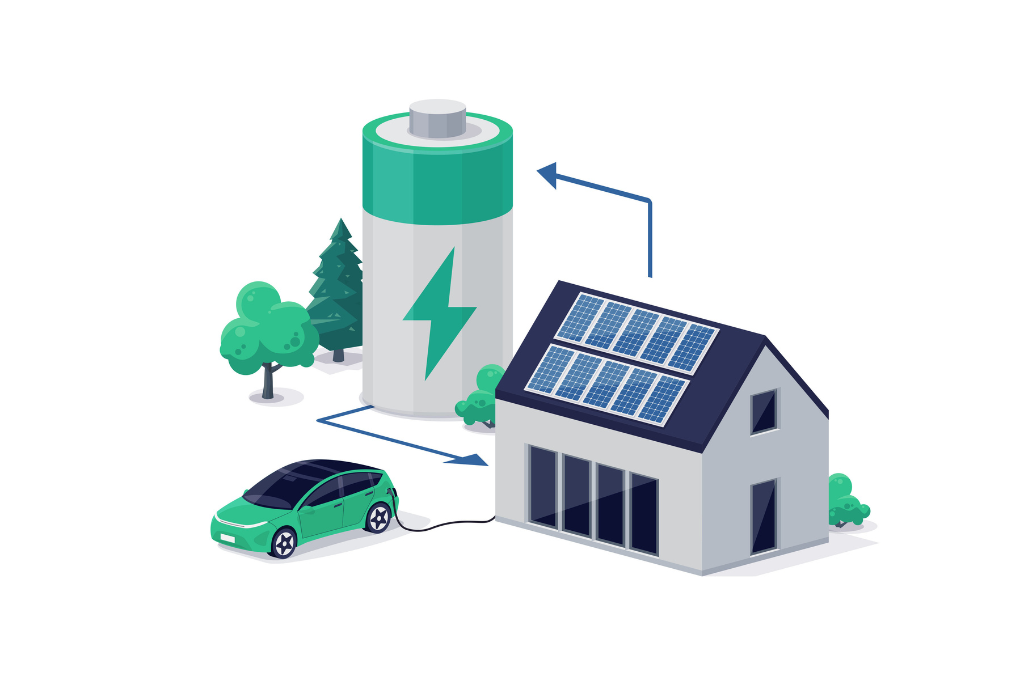
What does a solar battery do, exactly? At its simplest: it captures electricity your solar panels produce but your home isn’t using at that moment, holds it, and releases it later when you need it. That’s the core job. Everything else is detail on top of that.
2. How your solar panels and battery work together during the day
When sunlight hits your solar panels, they generate DC electricity. Your inverter converts that into AC electricity – the kind your appliances actually use. During the day, if your panels are producing more power than your home is consuming at that moment, something has to happen to that surplus.
Without a battery, that surplus gets exported to the grid, and you receive a feed-in tariff – a small payment per kilowatt-hour that, in most states, has dropped considerably in recent years. With a solar and battery system, that surplus goes into the battery instead. You’re essentially banking your own energy rather than selling it cheap and buying it back expensive later.
3. How is solar energy stored?
This is where the chemistry comes in – though you don’t need to go deep on it to understand what matters.
How is solar energy stored in a home battery? The electricity generated by your panels is used to drive a chemical reaction inside the battery cells – most commonly lithium-ion, the same basic technology in an EV – that stores energy in chemical form. When you draw on the battery later, that reaction reverses and releases the energy back as electricity.
The important practical point here is that storing solar energy in batteries involves some energy loss in the process, because no storage system is perfectly efficient. But a good modern battery will return around 90% or more of what went in, which is efficient enough that the losses rarely factor meaningfully into the decision.
4. What happens when the sun goes down
Now we get into the part most people are actually asking about when they look into batteries.
During the day, your panels cover your usage and charge the battery. Once the sun drops and your panels stop producing, your home starts drawing from the battery instead of the grid.
How long that lasts depends on two things:
- How much energy went into the battery during the day
- And how much your household uses in the evening.
A typical Australian home with a 10-13kWh battery and moderate evening usage will often make it through to morning without touching the grid at all. That’s the goal – and it’s increasingly achievable with correctly sized systems.
5. Charging solar batteries – Who’s in charge?
Charging solar batteries isn’t something you manage manually. The system’s battery management software handles it automatically, making real-time decisions based on:
- How much solar is being produced
- What your home is currently consuming
- How full the battery is
- And – in smarter systems – what the time-of-use tariff situation looks like on your energy plan.
Better systems can also be programmed with priorities: charge from solar first, only draw from the grid if the battery drops below a set threshold, and so on.
Some are even sophisticated enough to forecast tomorrow’s weather and adjust charging behaviour accordingly.
6. What happens when the grid goes down
This one surprises a lot of people. A standard solar system – panels and inverter, with no battery – actually shuts down in a blackout.
And it’s actually a safety requirement: it prevents electricity from feeding back into the grid while workers are trying to fix it.
Solar battery storage systems with the right setup change that equation. During a blackout, the system can disconnect from the grid and run your home from the battery and panels in what’s called islanding mode. Whether your system can do this depends on the inverter and battery you choose – not all configurations support it – so it’s worth asking specifically if blackout protection matters to you.
7. How does the battery know what to do?
The short answer is: the inverter.
In a modern solar and battery setup, the inverter is the brain of the operation. It monitors power flows in real time – from the panels, from the battery, from the grid, and from your household loads – and manages the whole system accordingly.
How do solar batteries work Australia wide specifically? The same way they do anywhere, really – but with one addition worth knowing. What’s that? It’s that the federal rebate requires batteries to be VPP-capable – that is, technically able to connect to a Virtual Power Plant, which allows your battery to be called on during grid stress events in exchange for credits.
Joining a VPP isn’t mandatory, but the capability must be there.
8. What affects how much power you actually get?
A few things influence real-world performance here:
- Temperature is one – batteries are less efficient in extremes of heat or cold, which matters in Queensland summers.
- The battery’s depth of discharge matters too, as most batteries don’t cycle all the way from 100% to zero, and the usable capacity is what you’re actually working with day to day.
- And the size of your solar array determines how reliably the battery gets topped up – an undersized array and a large battery is a combination worth thinking carefully about.
9. One battery or several?
Some of the most popular battery systems on the market – ask us about the brands and models – use a modular design where multiple battery units stack together to create a larger system.
Under the federal program, multiple modular units installed at the same time count as one system for rebate purposes, which makes scaling up more accessible than it used to be.
So … Does it make sense for your home?
How does a solar battery work? Once you get that answered, it’s only step 1. Whether it makes financial sense for your specific household depends on:
- Your energy usage
- Your current solar setup
- Your electricity tariff
- How you’d size the battery system.
What the federal rebate has done is shift the calculation meaningfully for a large number of Australian households. At around 30% off the upfront cost, systems that previously sat just outside a reasonable payback period are now worth a very serious look.
At Solar Repair Service, we work with Brisbane and Sunshine Coast homeowners across all aspects of solar – including helping you understand whether your existing system is battery-ready, what’s involved in adding storage, and what to look for in a quality installation.
If you’re trying to work out whether a battery makes sense for your home, get in touch with the friendly team today for straightforward advice and upfront pricing.